fbpx
Article

Cargo Trailer Conversion – Solar Installation

Trailer conversion…the saga continues. Actually, after this update the only thing remaining to install is the window. So the conversion is getting close to complete. When I decided to go with solar as my power source I had 3 main hang-ups with roof mounting a panel. 1 – I wanted to put as few holes as possible in the roof for obvious reasons. 2 – it needed to withstand wind from travel. 3 – I wanted the panel to be removable so I could store it when not in use, to extend the life of the panel. I think I found a solution, and in this video I outline the steps to install a panel meeting these criteria! 

As always, thanks for listening and watching!

Article

How To Convert a Cargo Trailer Into A DIY Mobile Hunting Rig—Part 2

This is part 2 documenting my cargo trailer conversion. During this episode I’m installing, insulation, paneling, heating and prepping to install solar power. The build is coming along much better than I expected and I’m looking forward living out of it for a few weeks this fall! There’s one secret install I’m working on that could allow me to work remotely to extend hunting trips – stay tuned for that update! I’m already daydreaming of the deer this thing could haul out across the country – I can almost see the blood trail!

Article

How To Convert a Cargo Trailer Into A DIY Mobile Hunting Rig—Part 1

This is part 1 of a two part series documenting my cargo trailer conversion. I’ve always wanted to convert a cargo trailer into a DIY mobile hunting rig. I travel to hunt every year on DIY public land hunts and decided I needed living accommodations as mobile as I like to hunt. No more getting locked into a piece of public because of a cabin or hotel location. No action, or too much pressure, I can pick up and move to a new piece and freelance my way to a filled tag!  Part 2, sharing the end product coming soon!

Article

Planning An Out Of State Public Land Hunt: Ohio 2016

Last year I considered heading to Ohio for a late fall DIY public land archery hunt. I’ve never hunted Ohio and was planning to tag along with a few friends who make a trip to the Buckeye state regularly. Unfortunately, our plans fell through, so this season I decided I’d make plans to go solo if need be.

Hunting a new state can be a challenge, and visiting new state to hunt public land has the potential for disaster. There are oftentimes more questions than answers. What part of the state has good hunting? How much public land is available to hunt? How much hunting pressure do public lands get in Ohio? Despite the challenges, I was determined to complete this public land hunt in 2016.

Location, Location, Location

When I began planning, the only thing I knew was that I’d be hunting public land in Ohio. I chose Ohio since it’s the closest big buck state to me, geographically, and out-of-state tags can be purchased online at a reasonable cost. My next step was to figure out in what county I’d be hunting. After I did a little online research, I quickly realized that Ohio has more public land than I had anticipated.

I determined I’d like to hunt in the southern region (a known big buck county) of the state and was intrigued by the AEP land. AEP land is land once strip-mined for coal in the 1940’s and eventually purchased by AEP. Since then, a vast reclamation project, to the tune of 60,000 plus acres across the state, has created ideal habitat for a variety of wildlife.

The Ohio DNR and AEP website were great resources for my initial map and habitat research.  I was able to view maps for various locations and read descriptions of the habitat and type of wildlife the specific sections of public land is best suited to support. Some lands were focused on providing grasslands for bird hunting and smaller game, while other sections centered on more big timber and row crops for larger game.

With the county determined and a few larger tracts of public land selected, it was time to begin zeroing in on land features, topography and working toward identifying specific hunting locations. I first used a standard boundary map on the AEP website to identify what was public land vs. private land and to eliminate areas that may be used by hikers, bikers, campers etc… I wanted to get as far away from human activity as possible. After surveying the boundary maps I decided to focus on an area of river bottom to the north with steep ridges to the south.

Online Scouting

Since I live a little more that 7 hours away from where I’d be hunting, doing a drive by scout of the area wasn’t an option. My only option was to do my initial scouting online to uncover potential hunting locations. This helped me narrow my focus of land features I’d like to scout and be more efficient once I got to Ohio. One of my favorite scouting tools to use (regardless of my familiarity with a piece of land) is Google Earth. This is my go-to resource any time I’m reviewing new possible hunting lands.

While reviewing aerial images, I was looking for land and habitat features that may attract and hold deer. Ideally, areas that would be difficult to access, more than half mile from the access point, found their way to the top of my list. I also looked for areas with a reduced likelihood of running into other hunters, elevation changes with varying terrain features (saddles, pinch points, and drainage cuts), a food source if possible, and adequate cover. After several hours of scouting using Google Earth, I found a handful of locations that peaked my interest.

The area I was most interested in was a river bottom with two larger cornfields separated by a small strip of timber and a deep drainage cut running through. On the opposite side of the corn fields is a sharp elevation change, with what looked like a bowl feature at the top of the ridge. From what I could tell online, this area looked like it met all of my search criteria. I dropped a few pins on Google Earth and logged the GPS coordinates. Now it was time to put boots on the ground to confirm my online scouting assumptions.

Satellite image of the area I scouted. The pin to the far left will be the area I focus on this November
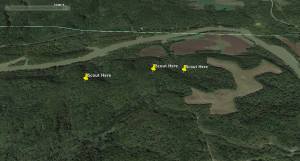
Ohio Public Land

Boots On The Ground

With my GPS coordinates logged, I set a date for a scouting trip to the Buckeye state. During the course of planning, my friend Tate and his buddy Eric decided to join me this fall and both were game for a late summer scouting trip. Two weeks before our scouting trip we had a meeting to iron out the details of where we were headed and the areas we’d be scouting. We met at Eric’s house and enjoyed a frosty pilsner as Eric gathered his folders containing the maps he’s used on his previous hunts in Ohio. I wasn’t sure where Eric had hunted in the past and was willing to change my hunting locations, even if he preferred a different county than I had scouted on line. After all, he’s been hunting Ohio Public land for years and would have a sense of where the better hunting would be.

We finished our beers and and Eric began pulling maps from his folder. At this point Eric has memorized land features, crop rotations cycles and perennial rub lines.  After sharing a few maps and thoughts, I asked what location he’d prefer to hunt.  As luck would have it, for 7 years Eric had been hunting the land I wanted to scout—it’s like we were meant to take this trip together. Having Eric on the trip would certainly cut down on some of the guess work.

4 a.m. came early on September 10th. I met the guys and we piled into my truck and headed west on the PA Turnpike, arriving at our destination around 8 a.m.  The food sources in this area were vast. Acres upon acres of corn and soybeans grew in every direction. There was no evidence here of the drought that we were experiencing across the state line. The timber was made up of a variety of hard wood with thick undergrowth—ideal whitetail habitat. The ridges were steep and the amount of green briar and brush made navigating the terrain difficult. The Google Earth images were as accurate as I’d hoped for.

We scouted a few locations where Eric had hung a few stand in previous years before heading to the area that I was hoping would be my go-to spot. Once I got into the timber, I immediately noticed a handful of nice rubs at the base of the ridge. I began working my way up the ridge and came across several deer trails, with a well worn deer trail running diagonally up the ridge.

Rub from last year at the base of the ridge. This rub line runs the length of the ridge bottom.
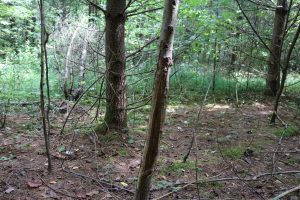
Scouting Ohio Public Land

The entire ridge was thick and nasty with green briar. Once I made it to the top of the ridge, there was a small clearing in the brush with a tree that seemed well suited for a climber.  I also noticed this tree sat at the head of a drainage cut and on an edge where the brush gets almost impassably thick. The trails running the side of the mountain all led to this thick cover. It was clear deer were using the low lying feature of the drainage cut as an additional travel route and working the edge of the habitat change of the ridge top. This would be the location I’d focus on this November.

While scouting online I noticed the back side of this ridge had small depression between this ridge and the ridge just to the south. In general, I like terrain changes like this and in this steep country it seemed like a low lying area deer may use as an easier path to travel the ridge top.  I hiked out along the ridge top and dropped down the south side and into a bowl. There was buck sign everywhere along with some more well worn trails. This is one of those spots you get a feeling about. Something tells me this would be a great location and I’m pumped to spend some time hunting this area next month.

Final Thought

With my trip only a few weeks away, I feel confident about the locations I pinpointed in Ohio. My drive-by scouts consisted of pinch points leading into a food source  that I could clearly see on Google Earth and identify by driving past the location. The drive-by also confirmed what I assumed from my online scouting and the plan is to mix in these locations during my hunting trip. I’ll plan to hunt Ohio a few days during the first and second week of November, a few days in late November, and again in late season.

I’ve been looking forward to this trip for a year and am trying to keep my expectations reasonable. The possibilities and the unknowns of this trip, however intrigue me. Regardless of the outcome, the preparation, anticipation, and time spent with fellow hunters will keep me coming back for more.

Article

Weekly Harvest: 7/15/16

Weekly Harvest

Happy Friday Everyone!

Another week closer to archery season—roughly 2.5 months until the state wide Pennsylvania archery opener. I’ve managed to keep myself busy with lots of range time but the buck fever is really starting to set in. Every night before bed I go over all the potential stand locations for this year in my head…it’s been great for my sleeping pattern.  It’s been a few weeks since I’ve checked game cameras. I’d like to say it’s because I’m practicing restraint and hitting the timber less…but that’s false. Truth is my family and I have been full swing into our summer travel plans. So I’m following good camera checking habits by default!

More family fun this weekend, but before I go I’ll leave you with this week’s best deer news from around the world whitetail web—enjoy!

Best Time To Plant A Food Plot: These tips can help keep your property from tuning into a doe factory.

Debunked—Your D-Loop Length Is Too Long: I’m definitely checking in to this.

Top 5 Ways To Spook A Buck: I’m sure we’ve all been guilty of 1 or 2 of these.

Whitetails: EHD Weather Has Arrived: The super wet spring has turned those would be little streams into mudflats…ripe for midges to thrive.

Deer Hunting’s Tailgate Ties: Tailgate stories are still one of my favorite parts of hunting.

Article

The First Hunt

My First Hunting Memory

Do you remember your first hunt? Of course you do. Most of us can probably remember the breeze we felt, the smells, the sounds, and our exact surroundings that day. I know I can. It’s one of those memories that no matter how old I get and how much time passes, will stay with me forever. My dad woke me up early. It was the first day of rifle season in Pennsylvania. It was a typical November day in PA with grey, overcast skies, a steady breeze, and…finger numbing temperatures. Now I’d like to say the story ended with an incredible hunt and the taking of a nice buck, but that would be a lie. The truth is, I was so cold and so tired that I eventually found a piece of soft ground, laid down, and fell asleep. I don’t even know if there was a sighting of a deer that day. Nevertheless, that day was memorable because it was the day my dad began to pass down the heritage of hunting to me. During my teenage years, my dad continued to teach me how to hunt, but more importantly he taught me how to hunt ethically and safely. I can honestly say my ethical approach to hunting and harvesting game is all due to my dad’s teaching and I’m grateful for the time we’ve spent hunting together.

A Hunter’s Obligation

I’ve recently done a bit of reading on the importance of passing our hunting heritage to the next generation of hunters. Passing down this heritage to a son or daughter, nephew or niece, or to a younger sibling is likely the most important obligation we have as hunters.  As Father’s Day is nearly here, I’ve been reflecting more and more on my first hunting memory and my obligation to pass this hunting heritage along. My own daughter has shown an increased interest in hunting over the past year. At seven, she is already learning to shoot a compound bow and began practicing her gun skills earlier in the year with her pap’s .22. She enjoys going to the farm and helping put out mineral stations, but really she just loves the outdoors. For months she had been pestering me to take her hunting, so I promised her a spring turkey hunt.

The First Hunt

Turkey season arrived and the weather was pretty awful just about every day. Cold and rain don’t exactly make for an ideal first hunting experience. Memorial Day weekend was the last Saturday of the season and the weather was finally looking good. I intended to keep my promise to my daughter, so I packed up the family and we headed to the farm. I’m pretty sure I was more excited for this first hunt than my daughter.  Four-thirty on Saturday morning came quickly, and it took a little more coaxing than normal to get her out of bed. But once she was awake, she was ready to go. We packed up our gear and headed to the blind along the edge of a small field on the northwest part of the farm. My buddy Tate joined us and headed off to the ridge to our south.

Once we got to the blind, we set up our decoys and settled in. The first part of the morning was extremely quiet. There was no wind to speak of and a really thick fog had settled over the field after the night’s rain. About twenty minutes in, I heard the first gobble. My daughter had never heard a turkey gobble before and totally missed it while she was digging through her bag for a snack. I waited a few minutes and told her to listen while I gave a call with my slate call. Two gobblers immediately responded. A look of astonishment crept across her face. I then gave her a turn with the call. She actually got a few responses, likely shock gobbles, but she didn’t care and neither did I. We called some more with a few response, but as the fog lifted, I could hear both birds moving away from us. At this point, we had been in the blind for nearly 3 hours and I could tell my daughter was getting tired and the snacks were gone too. I could’ve sat longer, but it was important to let my daughter dictate the hunt and make sure she had a good experience, so we began to pack up our bags. Just about that time, I heard Tate shoot and soon after received the confirmation text of a bird down. We finished packing up our gear and walked back to the car to go check out his harvest.

Tailgating

Tate is a great hunting buddy, friend, and might be an even better story teller. Tate explained how the hunt came together, and my daughter was glued to his every word. She’s an avid reader and loves a good story, and this one did not disappoint. On our walk back to the car, we talked about Tate’s hunting story. I explained that sharing hunting stories is how hunters share experiences, knowledge, and grow a bond with each other. In some ways, the stories are even more important than hunting. She seemed to like the idea of story time at the end of each hunt.

Here’s a picture of Tate with his nice Pennsylvania bird

Turkey Hunt

Final Thoughts

I don’t know if my daughter will want to continue hunting as she gets older, but my hope is she will. For now, we have a squirrel hunting date set for the fall and a youth turkey hunt planned for next spring, which is good enough for me. Whether she continues hunting or not, all I really want is for her to remember this day as fondly as I will. Truthfully, when I was a kid, I didn’t think much about the day my dad first took me hunting, but my dad understood its importance. And the impact of that one hunt is clearly felt and remembered even today. I can only hope that it is the same for my own child, as the hunter’s heritage is passed on, from father…to son… to daughter.

Article

2015 Archery Season: Recap

It’s official. My 2015 deer season has finally come to a close. The post season blues will no doubt begin to set in. All year I look forward to archery season, but once it arrives I’d like to be able slow down time and make those days and weeks last just a little longer. Whether it’s watching the forest unfold as the sun rises on a cold, brisk morning or returning to camp in the evening to share stories of the day’s events over a good glass of bourbon, I embrace every aspect of the season. With the end of my season, I’ll quickly turn my attention to the off season and making shed traps, shed hunting and developing habitat enhancements needed at the farm.

As it is now officially 2016, I’ve begun to reflect on this past season. The hope is to find a few things to improve upon next season, helping me continue growing as a hunter.

The Good

Let’s face it; even if the season was awful, I was still able to spend time in the outdoors, which alone is cause for celebration. This year I was able to spend a total of 21 days on stand. This is a lot of time for me, considering I have to travel a few hours to get to our farm. This summer I also set a goal for myself to try patterning a target buck for the first time. I did pattern a nice 8 point. He was bumped by another hunter on the day I was planning to hunt his bedding area; however, I was successful in locating this particular buck’s bedding area and identifying the wind he’d use to access this bedding on the correct day. I just didn’t seal the deal by allowing a friend to hunt the area instead (hoping for deer god points for this). I was able to fill my doe tag though and put some meat in the freezer.

The Bad

This past spring a new clover food plot was planted on the farm, which would provide the only consistent food source in the area through October and November. Typically the corn comes off on our farm in late September and those fields that have been harvested are sewn with winter wheat and clover for a spring harvest and hay cut. Under normal circumstances these fields lay dormant until the spring thaw. However, this was not the case this year. With a warmer and more wet fall than usual, all fields sewn for the spring sprouted by late October providing the deer herd an abundance of food in three additional locations. The distinct trails leading to the planned clover food plot, along with well defined staging areas, were now seeing much less activity than usual. The additional food sources impacted the overall deer herd’s fall travel patterns we had grown accustom to historically. This resulted in significantly less deer movement than in years past as food was overly abundant in multiple locations around the farm throughout the season.

 The Ugly

Simply put, the weather was ugly this season. I’m ok with wet weather or windy weather, but the heat during the beginning of November was less than ideal. Unfortunately I took a week’s vacation during the first week of November where temperatures here in Pennsylvania reached the 70’s. Needless to say, deer movement came to a screeching halt and buck sightings were few until the weather broke the last week of the season. This made for some long hours in the stand without any deer sightings and at one point I went three days without seeing a single deer.

Conclusion

With this season clearly in the rearview mirror, my hope is that I’m a better hunter because of this season’s experiences. Most of my negative experiences this year were weather related and I certainly can’t control the weather. On bad weather days, I simply should have stayed out of the stand. I know quality hunts are better than the quantity of hunts, and I need to do a better job of following this rule in the future. I’d be lying if I said I kept my cool through all of this season’s challenges. At moments I did allow the combination of slow days on stand and the warm temperatures get the better of my emotions. In many cases, success in the whitetail woods is a matter of a positive outlook, especially on those long sets with no action. Your fortunes can change in a matter of seconds during the season and a lapse in focus can be what stands between you and your moment of truth from the stand.

Article

2015 Archery Season: Rutcation

Rut-cation is over. No more 4 am alarms, no more long hikes with heavy gear in the morning darkness, and no more long sits with no deer movement. By most people’s standards this is the description of a miserable vacation. To us whitetail addicts, it’s simply the cost of doing business and we love it.

My official rut-cation began the first week of November and I had 10 days in the timber in early November to take one of the target bucks on our property.  I was also looking to take a doe helping to reduce our overall doe population—and put meat in the freezer. I identified four bucks as my targets during the course of the summer, fall and earlier season hunts. Below are a few pictures of the identified.

Target Bucks

The two on the right were our shooters and were identified during the summer months. Both of these guys stuck around our property throughout the season. The one in the middle is Jeff Reed, named after the fiery former Steelers kicker, due to the kicker on his left G2 making him an 11-point. The buck on the right was just simply named 8. They both are younger than I had hoped, but are certainly nice deer for this area of Pennsylvania, particularly Jeff Reed. Unless he presented a “can’t resist” shot, he would get a pass this year. I aged him at 2.5, and he could be a really nice buck if he could make it one more year.

Below are a few pictures of Jeff Reed throughout the fall. He disappeared for a while, but we did have an “on the hoof” sighting the first week of November and one additional camera image of him that month. Our live sighting was on the opposite side of the property from where we had been seeing him during the summer and early fall.

 I had only one additional picture of my targeted 8 point in the image above. He was also sighted “on the hoof” on 2 occasions during the season. These sightings and this additional image, gave me a pretty good idea of where he may be living. The time on the photo below is incorrect, it should be 7:15 am.

 Later in the season I had a late addition 8 point added to my target list. I had multiple daylight pictures of this guy running this same trail between two micro food plots.

 And finally, Dirty Harry. This guy’s rack may not be all that impressive, as he’s a big 6, but his body is huge for a Pennsylvania deer. He is the oldest deer I had on camera, I’m thinking he’s about 3.5 years old, but the latest picture I had of him made me think he may be a 4.5. We had no pictures or sightings of him until he showed up tending a mock-scrape I made in late October.

The Hunt

I typically take the same period of time off from work each year as my rut-cation at the beginning of November. This year was no different. After work on Friday October 30th, I quickly packed my car and headed west on the Pennsylvania turnpike for my 3 hour drive to our farm. A lot of work had been done at the farm this year to enhance the habitat. I had done more preparation this year than any other season before, and was hoping this work would pay off. As I pulled into the cabin, I could see there was a deer hanging beneath the deck. My father-in-law had taken a doe that evening. It seemed like a good start to the next two weeks.

Saturday’s weather looked good, not as cold as I’d like, but in comparison to what was coming later in the week, it seemed like one of the better days to try to fill my buck tag. I had a camera image of the one 8 point I had targeted and live sightings that told me he was cruising a hollow between a doe bedding area and a clover field. I climbed a tree in this hollow Saturday morning and was shut out on the day–nothing. Not a single doe. This was unusual as this hollow has historically been a heavily used travel corridor. There is no hunting allowed in Pennsylvania on Sundays, so I used this as an opportunity to check game cams, freshen up some mock scrapes, and do some scouting since it had been a few weeks since I had last been to the farm. Based on the the camera image of the 8 point above (10/8 image) and some live sightings, I had an idea where he may be living. I found a few scrapes, and then his rub line that ran the length of a ridge into a pine thicket. Along the mid-point of the ridge and and again 300 yards further to the point, I found 2 classic buck beds. I studied the camera data, and looked back at the dates of the live sightings and realized every time he’s been sighted and traveling this particular area was on a west wind. I looked at the upcoming weather and like most of the deer hunting country, we were set to have some unseasonably warm weather during the next few days. Monday’s wind wasn’t right for me to hunt the point of this ridge, but Tuesday had a west wind coming in, and it was the last morning of “cooler” weather before the temps jumped.

Before I set out on Tuesday, I learned a friend was coming to camp to turkey hunt Tuesday morning. I had a west wind on Wednesday as well, and decided to head to the creek bottom of the property Tuesday morning instead of the ridge point. Hunting the creek bottom as an observation set was an attempt at keeping the pressure to a minimum on the point I had determined was likely my 8 points’ bedroom. Unfortunately, during the turkey hunt that took place, my target buck was jumped from his bed on the ridge point, and was never seen again during the next two weeks. I’d be lying if I said I wasn’t disappointed in the outcome of that morning. I had spent hours, beginning in the summer, checking trail cameras, planting food plots, moving cameras, making mock scrapes, and scouting, with the hope that I’d have enough information line up to make a good attempt on a nice buck I had specifically targeted. Even with this misfortune, there were still hunts to be had.

 The next few days were warm and deer movement came to a screeching halt. I know anecdotally, warmer temperatures typically will reduce deer movement—even though QDMA studies say temperature has no impact on movement (good podcast discussing this and more rut info here). With that being said, I’ve never been shutout on so many hunts as I had this year. Historical hotspots we’re completely dead. And then it dawned on us what we might be experiencing. We have a 5 acre clover plot that is the green food source on our property, and is really the only source of consistent food once the corn comes off in late September. These cut cornfields are then sewn with winter wheat, and typically never sprout due to the cooler fall weather. This year the winter wheat was put in slightly earlier than usual and the rainy and warmer weather this fall allowed the wheat to actually come up to the point that it provided an additional food source—the deer didn’t need to travel for food and were bedding in brush right off the edges of these fields. Once we adjusted, we began to see deer and my father-in law had two encounters with Jeff Reed—but no shot.

As my rut-cation was coming to an end, I had gotten over the disappointment of my target 8-point being bumped. I hadn’t had any encounters with shooters, and was at this point looking to take a doe just to put meat in the freezer. I set out Saturday morning (my last day) to hunt a brushy hollow near the clover field. There were consistently a few deer feeding at the top of the clover field in the late morning and I had hypothesized that they were using this hollow to get there. It was really a Hail Mary, but this hollow would allow deer to remain under cover as they came off the mountain. I picked out a poplar tree and climbed to about 25 feet. At 7:30 am I heard something approaching from behind me and to my left. I thought it was a couple squirrels but looked over my shoulder to see two deer approaching me. I didn’t have time to turn on my camera as they were close and waited until the lead doe’s head was behind a tree to grab my bow from the hanger. She cleared that tree and gave me a 25 yard broadside shot. I didn’t have time to stand, so I gave her a quick mouth bleat and released the arrow. She made it 40 yards before she expired. It’s pretty amazing how quickly one’s fortune can change in the timber. In 30 seconds I went from thinking I was going home empty to getting a kill.

 This was one of the toughest, and most mentally challenging archery seasons I’ve had. I’m thankful for the doe, as she saved my rut-cation. And looking back, my hunt was more successful than I probably realized at the time. I had never patterned a buck before  and all my work leading up to the season did pay off. I was correct about my 8 points’ bedding location, and the wind he’d travel on. And the doe is helping me to continue to build confidence in my shot for when I put all the pieces together for my future moment of truth from the stand.

Article

Making The Best Of It: Opening Weekend at The Farm

As luck would have it, my much anticipated opening day on our farm was a soggy monsoon. I don’t mind hunting in the rain. In fact, a little cloud cover and some “light” precipitation can do wonders for deer movement, but this was not one of those times. A hurricane had been sitting off the east coast and it poured for the better part of 3 days. The rain and wind didn’t deter me, though. I went to the timber and hunted the edge of our property with my trusty Lone Wolf climber. Given that the weather was poor at best, I decided to head to an area of our farm that I’ve not hunted all that often to do a recon sit. I have a few camera pictures of deer movement in this area, but my hunt was a bust as I came up completely empty. The only good thing that did come out of the hunt was discovering my rain gear actually worked well, and my makeshift rain shield kept my cameras dry.  While I sat in the rain, my father-in-law stayed dry and had more deer action from the window of our cabin than I did. Sitting in his rocking chair, he saw two nice shooters cross the field into a known bedding area to the west of the cabin—I filed this info away for later use.

With my Saturday hunt a bust, I decided to use the damp conditions to my benefit and make something of the weekend. The wet conditions that continued into Sunday (no hunting on Sunday in Pennsylvania) were ideal for keeping scent to a minimum while in the timber, so a friend and I decided to do some stand maintenance. We moved a stand location to a field edge off of a saddle connecting two cut corn fields—now winter wheat. This location is notorious for deer movement on our property, particularly during the rut. I’ve had several encounters in this area with mature deer the past few years and we’re hoping our decision to relocate the stand pays off.

New stand location 

 With the new stand location in place, I turned my attention to pulling camera cards and moving a few camera locations. My cameras were still in their summer locations, predominantly over food plots and mineral sites. This time of year I like to move my cameras further into the timber along travel corridors and near known scrape locations. This year I’ve also decided to make a few mock scrapes using Smokey’s Preorbital Gland Lure. I’ve heard good things about this lure and wanted to see for myself how well it performs; the photos will tell the tale when I check them the third week of October. I also used the intel of the Saturday buck crossing my father-in-law witnessed and placed a scrape and camera on the edge of a thicket where I believe these bucks are bedding during the day. In this instance, I’m using the mock scrape to hopefully close the distance between my nearby stand locations and bucks who may travel this corridor. QDMA says 85% of natural scrapes are visited after dark. This is why I’ve placed my mock scrape in an area that historically has more daylight action—hoping to intrigue a cruiser. The past few months I’ve had a few camera pictures of a nice 9-point and an 8- point who like to enter this field during the same 8:30 AM time frame they were seen crossing on Saturday. Hopefully my mock scrape will yield some daylight pictures and confirm my assumptions, allowing me to target one of these daylight cruisers.

Here are a few tips on mock scrapes and how I made mine

  1. Mock scrapes can help enhance any stand location. I pick out a low hanging branch about 4 feet off the ground within range of any one of my stand locations. I try to make sure the position of the branch will afford me the best shot opportunity, while keeping the eyes of the deer averted. Once I locate an ideal branch, I generally apply some of Smokey’s Preorbital Gland Lure to the licking branch.

  2. With my licking branch picked out, I go ahead and scrape up a section of the soil below the branch using a twig or my scent free boot. Some like to place deer scents or urine in the scraped soil. I prefer to relieve myself on the scrape, as studies have shown deer do not react negatively to human urine. (This option is cheaper and can be fully accomplished with the help of a malted beverage—particularly if you’re making multiple scrapes)

  3. For those who may not have a branch that is at the right height for a licking branch, or an area (like the middle of a field) where a tree isn’t near, you can make you’re own licking branch tree! Here’s a how-to video:

Article

Deer Hunting & Scouting: Public Land

If you’ve read my previous articles, you’ve heard me mention our family farm and hunting property. It’s 240 acres of what I consider to be pretty fantastic Pennsylvania whitetail land and with the recent management approach we’ve taken, we should have even better hunting in the years to come. You can read more here (Whitetail Preseason Preparation: Setting Expectation) about our property management.  Although I certainly feel fortunate to have access to this land, our farm resides in the south central portion of the state near the Maryland border and is a three hour drive from my home in the suburbs of Philadelphia. This travel time significantly limits my hunting opportunities during archery season to a few Saturdays and a week’s vacation during the first week of November. This summer I decided that I’d try to find public land nearer my home to hunt when traveling isn’t an option. Another source of motivation was the early season opening in this part of the state and the opportunity to get into the timber sooner. I had little time and no prior experience with any of the land in the eastern part of the state. I had a lot of work to do and still not sure what my efforts may produce, but I was up for the challenge!

 My Approach

With limited knowledge of the area, I did a quick internet search for huntable state parks and  forests near me. I was willing to travel up to an hour for adequate hunting land and was looking for a piece of land, ideally, to the west, as I wanted to get further away from urban areas in hopes of reducing my run-ins with other hunters in the timber. I eventually settled on French Creek State Park as my destination.

 With my destination determined, it was time to assess the land for a suitable stand location. The park is over 7,500 acres with approximately half of it designated as huntable land. It would be impossible for me to scout over 3,000 acres in the one afternoon I had to find a stand location. So I made a plan and began with a virtual scout to focus my efforts once on site. Google Maps proved to be a great tool for this. Using Google’s satellite image, I could see the park layout and the neighboring land. I was looking for anything located remotely close to agriculture, but this feature was not an option. I then turned my attention toward the handful of what appeared to be thick brushy areas and decided this would be the area where I’d focus. With this small amount of information filed away, I made the hour drive to the park and paid a visit to the park office to grab a topography map. While sitting in my car, I did a quick review of the map and quickly ignored all areas with designated park hiking trails as huntable areas, with the goal of reducing the impact of human pressure. I then looked for topographic features, changes in elevation, pinch points, or creek bottoms. The northern portion of the park seemed the most remote and offered some elevation change with deep ravines and steep ridges and also included a stream. This would ultimately be the general area where I’d focus my scout.

 Once inside the timber, I knew I needed to hike in further than most people would be willing to with a stand and gear on their back to give myself the best chance of seeing natural deer movement. My goal was to hike a mile into the timber, knowing most public land hunters don’t typically travel much further than a half mile from their vehicle and entrance site. I looked for sign along the way and it was limited. After about 30 minutes, I began seeing sign that showed more promise–deer trails, scat and a significant amount of brush. I could hear a stream and started working my way toward the sound. The sound lead me through thick brush and to the edge of a deep ravine with the ridge lined in alder thicket. I found deer trails and bedding areas in the alder thicket and once I hiked down the ravine, there was a noticeable deer trail hugging the ridge line with the creek bottom supplying plenty of oak trees dropping acorns. I picked out a few climbable trees and had found my spot. This area provided plenty of cover, water, a food source, a topography change, clear bedding area, a natural pinch point between the ridge and the creek, and was relatively deep in the timber. In total, I spent two hours with boots on the ground scouting. Next was to hunt the location and see if my strategy and approach would pay off.

 The Test

Pennsylvania opening day had arrived. I was excited to get in my stand to say the least. Based on a few new strategies I’d implemented for this year, I previously decided to hunt only the evening set. The new (new to me) strategies were to hunt fewer mornings in October, unless camera, intel, etc.. tells me otherwise, and to use the Moon Phase Guide for the first time. According to the guide, I had a red moon for that evening beginning at 5:30 EST. I had thought if I was going to get any action out of this location, it would likely come from the thicket directly to my south. And for that to work I really needed any type of south wind. I arrived that afternoon, packed in my climber and gear, and climbed a tree about 50 yards below the pinch point between the ridge and the stream with the south wind I was hoping for. I honestly didn’t care if I saw a single deer, archery season was here and I was stoked just to be in the timber. A few  hours had passed with only seeing a hawk and one chipmunk. The moon time had arrived and I was hoping things would pick up. At 6 o’clock I heard some movement and spotted a deer coming from the thicket to the south. It was headed toward the ridge line just out of range. Two more deer followed the same path, all bucks–two 6-points and a nice 8-point! The two six points weren’t shooters but the 8-point was certainly a shooter, particularly for a Pennsylvania public land hunt.

 I’m not sure what was more exciting, seeing the first deer of the season from the stand or the fact that my strategy and limited scouting had worked! I’ll definitely be back to this location on weekends I can’t make it back to the farm. And I’ll make a slight stand tweak and move a little further up the ridge line to better cover the flat coming out of the thicket. I’ll also continue to use the Moon Phase Guide and will report back on the season-long outcome of this new strategy. Some may say that my hunt wasn’t a success since I didn’t get a shot or I didn’t kill, but I disagree. I implemented new strategies and put myself in position to see natural deer movement using a truthful approach and executing sound strategy. It dawned on me while climbing from my stand that this experience may mean more to my growth as a hunter than any buck or doe I may harvest this year. Why? Because I moved outside of my comfort zone and challenged myself to think differently about my approach in unfamiliar territory. These are the moments I seek most of all, as this day was clearly a moment of truth from the stand.