Trail Cam University: The Truth About Trail Cameras
In this kickoff episode, we break down the fundamentals of using trail cameras not as a gimmick, but as a strategic tool to scout smarter and hunt more effectively. This isn’t a gear review — it’s a deep dive into how real hunters use trail cam intel to gain a serious edge in the woods. 🦌 In This Episode You’ll Learn: Why trail cameras are more than just motion-triggered gadgets
The truth about cellular vs. non-cellular cams (and which one fits your hunt)
How to choose a camera based on YOUR specific needs, not hype Battery, SD card, and setting recommendations that actually work
A real story of one photo that sparked a two-season pursuit of a giant buck
Practical, actionable tips to make your camera setup work for you
EP. 396: Balancing Technology & The Hunting Experience
Hey folks, Clint here from the Truth From The Stand podcast. In this episode, I chat with Chad about what seems like the annual trail camera controversy and potential bans, questioning their impact on access issues. We stress fighting for hunting rights and better wildlife management.
We also touch on hunting access, land ownership, and tech’s role in the field. Hot topics like baiting, cell cameras, and fair chase get some airtime too.
Finally, we discuss prepping for Western hunts, from physical training to gear choices, and I share how shooting a longbow affects my compound bow skills.
Tune in and enjoy the show!
WHAT TO EXPECT FROM PODCAST 396
Controversy around trail cameras and potential state bans
Confusion on how trail cameras impact access issues and if banning them helps
Need for better wildlife resource management to secure hunting’s future
Complex issue of maintaining public land access for hunting
Unintended consequences of hunting content and technology on the community
Polarizing topics: baiting, cell cameras, and fair chase
Balancing technology use and preserving the hunting experience
Future of technology in hunting and its impact on access and recruitment
Preparation for Western hunts: physical training and gear choices
Shooting a longbow can enhance compound bow skills
Mental preparation is crucial for hunting in the West
Today on the podcast I’m joined by my buddy Brandon Barlow. Brandon hunts public and small permission parcels in the south. As a native New Yorker he’s had to adapt his hunting approach from relying on the historical calendar dates of good whitetail hunting…to now using long-term data to keep him in the game as his season is much longer. And the deer seem to have a much broader breeding window within specific pockets. He runs 100+ cameras a year and has been able to glean some pretty interesting observations. I’m a long-term data guy myself and I was looking forward to picking up a few new nuggets of insight for myself – thanks for listening.
Today on the podcast I’m joined by my buddy Chad Sylvester for part 2 or our listener Q/A session. These are always fun to – thanks for listening!
To listen to the podcast click the purple play button at the top of the page. You can also download the podcast via iTunes, Stitcher Radio and Google Play—don’t forget to share with your friends! If you like the podcast, please leave us a 5 star iTunes rating…we’d really appreciate it.
Building a Public Land Hit List of Highly Pressured Bucks
Bow season 2021 was a season for Dear Diary. It was an odd season for many, likely due to the massive acorn drop and warmer October weather. To all who put sweat equity into your season, well done. Even if you didn’t fill tags, it wasn’t for nothing. Every year, we learn something new about the whitetails that inhabit the areas we hunt; in the following years, that knowledge can be applied and executed.
There are only so many factors you can control in the woods. We can use the best clothing, climbing, gear, bows, scent control, scent attractants, and calls. We can practice shooting, place numerous trail cameras, run, lift weights, sleep well, and eat healthily. But In the long run, there is one key factor out of our control: what a buck will decide to do on a given day.
This year, a good buddy of mine and I made plans for a mission to build a list of bucks and do our darnedest to pin a tag on one of them. To say we worked hard is an understatement. We hiked miles and miles in 30 mph winds. We battled the cold temperatures of early spring to the muggy July heat. Through close encounters with rattlesnakes, ticks, and mosquitos, we successfully built a wish list of bucks.
Building a hit list of bucks is a cliché in the world of bowhunting. But at the same time, it was damn fun. Of course, it’s a labor of love, but, like anything, there were positives and negatives involved.
The Pros
At a minimum, when I found myself in the woods, I always learned something new about the property I was scouting.
Separate deer herds have independent habits, even if they’re only a few miles apart. Setting cameras up to soak for months is a great way to understand a specific herd.
While capturing images of bucks on public land, I didn’t only learn about what deer were there: I gained insight into what affected the deer I was hunting. Hunting pressure, predators, and weather all play a role.
Who doesn’t like to see pictures of “any ‘ol buck”? Good trail camera photos are all-around fun. Honestly, I was happy with more than half the bucks that showed up on our cameras from the start. As the season grew closer, we started recognizing a few specific bucks. Regular activity in this area made the idea of shooting a specific buck seem possible.
The Cons
Once I added the first couple of bucks to the list, becoming obsessed was almost unavoidable.
If I wasn’t careful, attempts to put the puzzle together drove me crazy many times. But it didn’t stop me from trying.
Hunting for specific bucks gave me thoughts of passing up bucks that otherwise would have made me more than happy.
I had to be very careful not to let my compounded excitement cause me to make poor decisions, like choosing a day with poor wind direction, not observing seasonal food differences, or walking past new sign.
In-Person Scouting
E-scouting and cameras were invaluable tools, but boots-on-the-ground scouting efforts were irreplaceable. Without time spent in-person scouting, our cameras would have missed so many important aspects that we built our hunts around.
Cameras provide a small snapshot in a big world. Sometimes that world is just on the opposite side of the tree. Cameras are only as valuable as the information that walks in front of them.
One camera we placed was on a scrape tucked into dense cover. That particular set, we had determined, was the hub of deer activity in the area. On almost every scouting trip, we ventured along the same routes used by deer. It wasn’t until the first camera check that we discovered trails on the outside edge of that cover. Physically laying eyes on those trails was crucial to finding them. Better yet, there was food on that outer edge. Had we not hiked in from a different direction on that venture, we would have missed that vital information about deer travel through that hub.
With in-person scouting, variety is the spice of life. Breaking a property down to a micro-level is something I do as soon as I’ve learned some basic features of that property. I want as many spots as possible on a single property to avoid putting too much pressure on one area.
It’s essential to find a spot or two where I won’t mind burning a sit to observe. After that, I look for sites to cover four different wind directions. On all of these spots, the more edges, terrain, and natural elements (food and water), the better.
Deer sign gets me just as fired up as the next guy. I love finding big sign, but I’ve often made the mistake of walking past new sign to work off of historical findings. Old sign is good information, but even if the fresh stuff isn’t impressive, it doesn’t mean that a small deer made it. Big bucks often make small sign, especially early on in the season. Mature bucks are also more likely to lay down sign first. Keep that in mind the next time you walk past that scrape that could pass as a turkey scratching.
Camera Work
In-person scouting only offers the element of surprise. It’s not always bad to rely solely on primitive scouting. Validating woodsmanship skills this way is a rewarding accomplishment. However, something is satisfying about capturing the same buck on different cameras repeatedly. When an actual encounter happens with that buck, that’s a whole other prize.
I tend to hesitate when it comes to placing a camera. So often, that brings me out of the woods with a bag that is still full of cameras. I’ve now begun to adopt the practice of “see a spot I like, drop a camera.” My intuition is on occasionally, but it usually takes a slight adjustment from the first location to get the correct result. Check out a few of the podcasts about trail camera strategies throughout the season – Summer | Fall | Lateseason
I try not to worry about hanging a camera, based strictly on what a deer’s present focus may be. A scrape may not be the hot spot in July, but by the middle of October, it will be. I hang my cameras in an attempt to cover a whole season’s shift. What I’ve found with collected intel is that those spots ebb and flow as far as deer activity goes.
A clear-cut pounded by velvet bucks in July might taper off by mid-September. But if it was hot once, there’s a good chance it will be hot right when I need it to be. Habits of deer often shift in the big woods as deer adapt to the changing conditions. Spurts of hot activity will be the result. If you leave your cameras stationary instead of shifting them to match what a deer “should be doing,” you’ll find this to be true.
Gear Drills
Practice with my gear isn’t something I like to spare. I’m new to saddle hunting this year, thanks to Clint, but if I hadn’t practiced climbing and shooting out of my Tethrd saddle preseason, it would have been a disaster. Practice doesn’t strictly mean archery practice. Knowing your pack and where things are, knowing your saddle pouches, doing a run-through with the clothes you’ll be wearing—those things are all critical. There’s a positive correlation between successful hunts and knowing your gear inside and out.
Conclusion
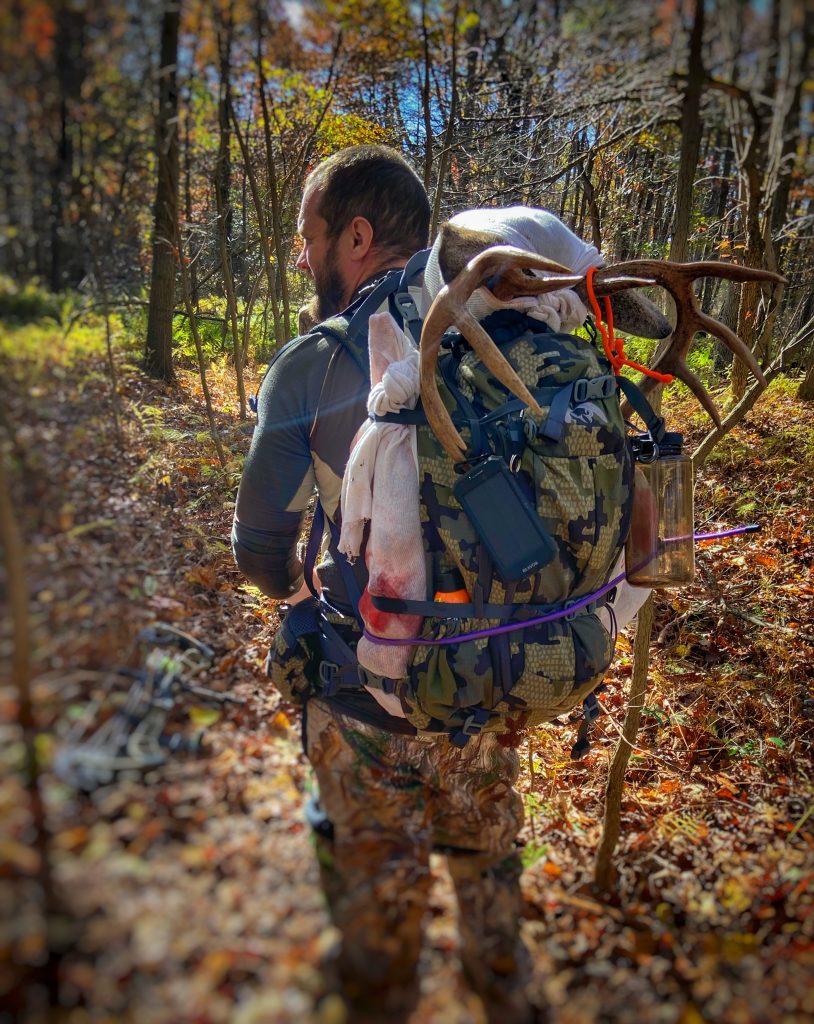
I’m thankful for good friends this year and all the effort every one of them puts into the sport of bowhunting. During this 2021 season, I was blessed with the opportunity to put a target buck in my pack. It was a long way to the truck, but every minute with the two friends I had with me was memorable. There’s nothing quite like a target buck pack-out.
Article
EP. 240: DIY Report W/ Chad Sylvester – Fall Trail Camera Strategies
Today on the podcast I’m joined by my buddy Chad Sylvester of Exodus Trail Cameras. I know we’re still in the dog days of summer, but soon we’ll need to shift our gaze from summer velvet to locating hard horned bucks we’d like to kill during the fall. With that shift in mind, your trail camera strategy and placements will need to change in many cases. Today we’re talking all about the summer to fall shift and what trail camera strategies and placements you should be thinking about to make this your best season ever. Hope you dig the episode…and thanks for listening!
To listen to the podcast click the orange play button at the top of the page. You can also download the podcast via iTunes, Stitcher Radio and Google Play—don’t forget to share with your friends! If you like the podcast, please leave us a 5 star iTunes rating…we’d really appreciate it.
What’s up gang! I’m joined again by my friends from Exodus Trail Cameras for part three of our Public Land Trail Camera Strategies. Today we’re talking camera strategies for rut and late seasons—thanks for listening!
To listen to the podcast click the orange play button at the top of the page. You can also download the podcast via iTunes, Stitcher Radio and Google Play—don’t forget to share with your friends! If you like the podcast, please leave us a 5 star iTunes rating…we’d really appreciate it.
What’s up gang! I’m joined again by my friends from Exodus Trail Cameras for part two of our Public Land Trail Camera Strategies. Today we’re talking camera strategies for early season and pre rut—thanks for listening!
To listen to the podcast click the orange play button at the top of the page. You can also download the podcast via iTunes, Stitcher Radio and Google Play—don’t forget to share with your friends! If you like the podcast, please leave us a 5 star iTunes rating…we’d really appreciate it.
Podcast #73: B.S. Session, One in hand is worth two in the bush
What’s up everyone! Today John and I have a good old fashion B.S. session and catching up on our summer progress as fall approaches. Thanks For listening!
To listen to the podcast click the orange play button at the top of the page. You can also download the podcast via iTunes, Stitcher Radio and Google Play—don’t forget to share with your friends! If you like the podcast, please leave us a 5 star iTunes rating…we’d really appreciate it.
—Use the promo code “truth” and receive a 20% discount on any Wicked Tree Gear,Glacier Coolers’ or Tecomate Seed Purchase and $20off any Exodus Trail Camera purchase!
Article
Filling Tags Using Historical Trail Camera Pictures
The whitetail off-season is in full swing and by now many of us have been out shed hunting, scouting, and beginning to plan for next season’s hunts. Although spring is here, we’ve recently endured our fourth Nor’easter here in Pennsylvania, which brought many of my off-season activities to a halt. As a result, much of my scouting has been moved indoors as I use e-scouting to view new properties and revisit trail camera pictures from past seasons.
I’m a firm believer that past behavior is a strong indicator of future behavior. Said more plainly, if a person is a subpar employee today, chances are they’ll be a subpar employee in the future. Applying that philosophy, it stands to reason that a buck’s past behavior would indicate his future behavior, too. This is exactly why I often review the previous year’s trail camera inventory to formulate this year’s plan when I’m patterning a specific buck. The current images are used to confirm the buck I’m patterning is using his same core areas throughout the hunting season, and to target any new bucks for the following year. The more historical data you have on a buck, the better your odds will be of harvesting him. You’ll usually get only one opportunity to do so, therefore the more you know about him the better. Here’s how I approach building a plan based on previous years’ trail camera pictures.
Inventory Cameras
Many hunters run inventory cameras during spring and summer to get a sense of the deer herd and the buck inventory on a property they plan to hunt. I do the same. However, I keep a handful ofExodus trail cameras out all year round to monitor food sources, so I know which bucks have made it through hunting season and which will be potential targets for the following year. For monitoring purposes, I’d recommend leaving cameras out at least until antlers drop in late winter/early spring.
Building Data & Aging
After I have an idea of which bucks have made it through the season, I’ll file away the images of those I consider potential targets for the next year. I’ll then compare the most recent buck images to images of bucks from years past to see if there is any recorded history. The goal is to try to identify these new target bucks with unique antler or body features (bend in a brow tine, a unique marking, etc). My goal is to not only identify and aggregate my data for a particular buck, but also accurately age the buck so I know if it’s a buck that should be hunted the following year. In Pennsylvania, I typically target 3-year-olds on family farms, as this age would be considered a mature deer in the areas I hunt. If all of this sounds a little overwhelming, know that there are cloud-based software tools that you can use to assist in organizing your data and trail camera images. I’ve used DeerLab in the past and it has worked well.
Laying The Groundwork
Now that I’ve identified a target buck and analyzed the top level trail camera data, I begin to look at the trail camera pictures with a more critical eye. I search for clues related to travel direction, wind direction, day or nighttime movement, and how his core areas shift as hunting season progresses. Often these clues are cause for more investigating, but that’s to be expected. As I collect and analyze this data though, I think about the still lingering questions in relationship to the property I hunt and how the information weaves a story. For example, if a buck is consistently traveling from the north an hour or two before dark toward a food source, chances are his daytime bedding is north of the camera location. Less eloquently stated, his bedding is likely in the direction his ass in pointed in the trail camera picture. This then leads me to search my OnXhunt app for topography and overhead imagery that would narrow down areas that look like good travel corridors in relationship to where he’s bedding and where he’s feeding. At this point, I have the information I need to make a move. I’ll choose a day with good weather and an “almost right” wind for him to use a particular travel corridor, and hope my planning pays off.
Putting it All Together
This year I worked this plan to near perfection. I had watched a deer for two years as he aged and reached the prime age of 4. Through the previous two years of trail camera images and three live sightings, I had aged this buck, identified his unique body and antler characteristics, narrowed down his daylight movement to only evening, and determined where he was bedding. Using Exodus trail cameras on video mode, I identified his consistent travel direction and corridor, and ultimately, the particular pinch point where he’d be killable. I had an encounter on opening day with this buck at 30 yards, only to be blown by the younger sidekick he was traveling with that day. He avoided my arrow yet again however, he fell to my buddy’s bullet during rifle season. UtIlizing the previous year’s trail camera data has changed the way I hunt. Even if I don’t fill my tag, I know I’ve put myself in a better position to season my tag soup with some great encounters.