fbpx
Article

Changing Your Food Plot Strategy? Here’s What I’m Doing

Food plot season is finally here! Spring signals two things for hunters—turkey season and the push toward next deer season.  I’ve done my scouting of a few pieces of public land, and two new private parcels where food plots are an option. In total, this year I’ll likely be planting food plots on 3 properties; this includes our farm which is 240 acres, 50 acres behind my in-law’s house, and a new 56 acre property my dad recently purchased. Each property has its own unique set of circumstances, so before beginning planting, I have to answer a few baseline questions.
1. What is the my overall objective for the food plot(s)?
2. What crops are already in play (spring/summer or fall/winter crops) and what is missing?
3. How much time do I have to maintain what I plant?
Of course a soil test is needed to make sure I’m choosing the correct forage. With that said, here’s how I plan to manage each:

Assessing The Farm

The farm is 240 acres, of which approximately 30 acres is tillable. We have a 5 acre plot of Whitetail Institute Perennial Clover that is going into its third year. Last year we planted an additional 2 acres of Whitetail Institute PowerPlant, which is great summer forage, with an overseed of tubers for late season food.  These two plots are on opposite ends of the farm and have historically been utilized by two separate groups of deer. The remainder of the tillable land is leased to a neighboring farmer and is typically sewn with corn, with a few acres kept for hay. Between our food plots and the farmer’s crop, we had a pretty good food plot system working. That said, crop rotation is a must and re-evaluation of our food plot strategy is required. This year the farmer will be rotating the corn out and replacing approximately 20 acres with alfalfa for the next 6 years. With this change we’ll have an overabundance of spring and summer food with limited late fall and winter food. Obviously, it’s time to switch things up. 

The Farm Plan

In all truthfulness, the farm’s food plots needed to be diversified, and now is the perfect time to revise our food plot strategy. With the introduction of 20 acres of alfalfa, the all important spring green up period for deer to rebound from the harsh winter months will be covered, along with summer food. The plan, therefore, is to add more fall and late season food for attraction during hunting season and provide more winter food (I’ve scouted the browse the past two winters and it’s been hit pretty hard which points to a lack of winter food on the property). What I also need to consider is the time required to implement and maintain the new plots. With potentially two additional properties to maintain this year, I’m opting for an annual forage. Yes, there is yearly work required to establish annual food plots, but I don’t have time to commit to spraying and mowing additional perennial plots a few times a year, so an annual for me is more manageable.

With that said, I’ll continue to maintain the 5 acre clover field, but till strips into it planting roughly half of the plot in Whitetail Institute’s Pure Attraction—this way our largest plot provides food for every season, and as deer move across it they’ll encounter each food variety.  The additional 2 acre plot will also be planted in Pure Attraction as this plot is an area I hunt during the late season. Pure Attraction includes oats, wheat, peas and a variety of brassicas including turnips. This combination provides the diversity of forage I’m looking for and is attractive to deer during hunting season along with increasing the late winter food source. I’ll also be planting a micro plot of Whitetail Institute’s BowStand in an old log yard. The plot will be approximately 5 yards wide by 15 yards long. BowStand is made to use in hard to reach areas where planting conditions may be less than ideal or equipment access is limited. I’ve used BowStand in this log yard with success in the past. During the rut, bucks frequently pass through this pinch point on their way to the clover field. This small plot is intended to have them pause long enough for a shot opportunity.

Assessing The In-Law’s 50 Acres

This property is comprised of a steep ridges and a  flat area which was an old log yard 10 plus years ago that sits just above a creek bottom. I hunted this property one time last year and had an encounter with a shooter 8 pt. My father-in-law hunted it a few days during the rut and saw 3 shooters, one that was mount worthy. The property sit’s just outside the town I grew up in, which would still be considered rural by most standards.  That said, this property is not in a heavy agricultural area so any food plots I plant will be the only game in town so to speak. I’ve also located 2 known buck beds on ridge behind the log yard and I’ve watched deer behind the house filter through the brush behind the house into the log yard while drinking my morning coffee. The log yard seems like it could be a good early season ambush spot.

The In-Law’s 50 Acre Plan

I’m hesitant to plant anything on the main ridge as the buck beds I’ve scouted are at the top third of the ridge and I don’t want to risk disturbing any patterns these bucks are accustom to. I also don’t want to plant a plot near the creek bottom for fear of getting too close to the neighbors. After I did a bit of scouting, I noticed a portion of log yard was overgrown and surrounded by brush and small pine trees with a well worn trail running through the center. The surrounding trees and brush give the area a sense of seclusion and safety while the path leads to an area of regenerative growth where I have already selected a few trees for stand placements. The total size of the plot will likely be a quarter of an acre. The plan is really to use this location as an early season ambush opportunity.  There is next to zero pressure on this parcel, so the goal will be to get one of the shooters to frequent this plot early in the season and go in for a strategic strike! In this plot, I’ll again use Pure Attraction as I’m looking for a low maintenance option that will be attractive during hunting season and will provide a variety of forage. The lack of pressure and the addition of a secluded food plot, lead me to be cautiously optimistic about the potential of this property.

Assessing Dad’s 56 Acres

Although my dad only recently picked up this property, I have had a chance to walk the property twice with my dad. Also, being that my uncle was the previous owner, we were able to get a little intel on the property from him. That being said, I’m taking a bit of a shot in the dark this year with planting a food plot on this land. My uncle has previously planted two very small plots with clover, something similar in size to micro plots. The property is in farm country, but the neighboring farms have placed their fields into the CREP program (Conservation Reserver Enhancement Program).

Dad’s 56 Acre Plan

At this point, you’re probably picking up on the theme that I have limited time for maintenance, but I do want to start somewhere with this property. This year I’ll plant a half acre of Pure Attraction on this property in an overgrown field near a fence row. The plan is to snake the plot along the timber edge to hopefully pull deer close enough to the timber to place a stand for a shot opportunity. This location makes sense from what I could gather during my scout, and the movement my uncle had seen the past few years. Truthfully, this year is all about observing and learning more about this property, and then hopefully being able to dial in a more strategic plan for the following years.

Final Thoughts

Planning and planting food plots is one of my favorite deer work projects. The most important part in my opinion is to start with a goal in mind, and build your plan to achieve that goal. Don’t be afraid to ask questions along the way and make the necessary adjustments based on your time and other needs. When my father-in-law and I first started planting plots we had a lot of questions. We’d talk to local farmers, our local co-op and had Whitetail Institute on speed dial! We’re proof that anyone can build effective food plots with a little planning. So get outside, get your hands in the dirt, and start planting and planning for next year’s moment of truth from the stand.

Article

Deer Scouting PA Public Land Video: Part 2

Two weeks ago I took to the timber  to scout a new piece of public ground and documented my scout in a 2-part video series. The scout hit a bit of a lull in the middle of the day with the area I was holding high hopes for leaving me a little disappointed. That said, the day ended on a high note and holds promise for next year!

Below is video 2 of this series, and you can view part 1 of the series here—enjoy!

Article

Deer Scouting PA Public Land Video: Part 1

Hey gang, If you’re like me you’ve been itching to get back into the timber and get your 2017 hunting season started. This past weekend’s phenomenal weather (and a 3 day weekend) gave me an opportunity to hit some public land that I had been planning to scout. I did manage to fit in a little shed hunting, but since I’m possibly the world’s worst shed hunter I decided to make a deposit in the 2017 big buck bank account with some scouting.

In this 2 part video series I”ll bring you all with me on a full day of public land scouting on a parcel I’ve only viewed from aerial maps prior to these videos. The total parcel is 1,700 acres, but I’ll  be focusing on only a few hundred.  These videos are meant to be DIY/no frills. Just scouting and putting in miles. Hope you enjoy the video, and part 2 will be coming soon.

Could YouTube find a more ridiculous shot of my face to use as a thumbnail?

Article

How To Manage Offseason Deerpression

Another deer season has passed and with it an abundance of memories to reflect upon. Unfortunately these recollections only get me so far through the off-season before I develop a full blown case of deerpression, especially as we hit these long, winter months. If you suffer from deerpression like me, you’re in luck, as I have a few tips to help get you through…at least until turkey season.

Plan A Hunt

Nothing cures a case of deerpression like daydreaming of wild places…and then envisioning a way to get there. Following deer season, I begin planning out my hunts for the following season, or two seasons depending on the scale of the hunt. Right now I’m beginning to prep for my upcoming DIY Montana elk hunt in September. Of course licenses/tags need to be purchased and gear accumulated. For me, this time is also used to up my game in the fitness department, to make sure I’m in tip-top shape to manage the terrain of the following year’s hunts.

If an adventure hunt isn’t in your plans for next year, start planning for a few whitetail excursions closer to home. Or dissect the land you’ve been hunting and tweak your game plan for how to attack your hunts next year.

Shed Hunt

Shed hunting is a great way to get back out into the whitetail woods and breath some hunting life into your winter. To be honest, I’ve yet to find a shed while shed hunting. But I’ll use any excuse to get back into the timber. Who knows, you may find the sheds from the toad that has eluded you all season. So meet up with a buddy or two and hit the timber for a shed hunt. Just be on the alert for the dreaded shed thief (who also doubles as “friend”).

Scout

If you’re like me, there is no real off-season, only a period of the year when deer can’t be harvested. When the weather is less than ideal, I take my scouting online and do some virtual work using Google Earth or other online mapping tools from the comfort of my couch. When I do get good weather days, I’ll hit the timber for a boots on the ground scout. Sign from this past year is still visible and provides a nice road map of how deer are using a property—-particularly if you’re scouting a with a little snow on the ground.  One of my favorite things to do is back track trails to bedding. This will give you a great idea of how the deer on a property are getting to and from bedding. The added bonus this time of year is you can scout secluded/sanctuary areas of a property, knowing there is plenty of time between now and next season for the deer to forget you were ever there.

Predator Hunt

If you’ve instituted quality deer management principles on your property, or hunt a property owned by others who have, predator hunting should be part of your off-season management plan. As you enhance your property’s habitat to attract more deer, the natural by-product is likely an increase in predators visiting or living on your property. Predator hunting is a new off-season activity for me this year as I’ve certainly noticed an uptick in the coyote presence on our property since we’ve begun enhancing our deer habitat. Not only does this activity help your overall QDM efforts, it’s also a great way to battle deerpression during the off-season.  Also, volunteering to do some predator hunting for a neighboring farm may be the key to unlocking hunting access to that land next deer season.

Turkey Season

If all else fails, turkey season is just around the corner. Before you know it’ll be early morning wake up calls with gobblers in the hollers! So break out the turkey call for some practice that is certain to drive your family crazy. They’ll prefer this over a potential bout of deerpression.

Final Thought

I’m as bummed as anyone that deer season is over and I usually do suffer a bit of deerpression. However, the off-season is a time of limitless possibilities and I enjoy finding creative ways to spend my time during these cold winter months. From developing your woodsman-ship  to rediscovering parts of your property, making good use of this time will pay off in a few months and make the 2017 season the best one yet.

Article

Deer Hunting Late Season Food Sources

Photo Credit: Charlie Coffey

There are plenty of articles sharing tips for hunting deer during the late season. Everyone has a slightly different take, but the general theme is, “find the food to find the deer.” Typically this means find yourself a cut corn or soybean field and set up shop. If you’re lucky, maybe you’ve planted a late season food plot for just such an occasion. These are all great choices, but what if these traditional food sources are scarce, or your hunting an area with little agricultural land? Should you just wait until next year? No. And you don’t have to. There are plenty of other late season food sources that could prove to be where you find Mr. Big this time of year. So throw on some thermals and hit the timber and do some deer hunting late season food sources.

Browse

This is probably my favorite late season food source set up. I know this is a broad category, but after a full season of hunting pressure, the deer herd will be more inclined to stick close to thick cover.

Look for wind damaged areas with downed trees or areas of recent logging activity. These areas provide great deer cover for daytime movement and plenty of daytime browse in the form of poplar buds, young saplings, and green briar. There should be plenty of sign/trails leading to and from these sights to make set up pretty easy.

Acorns

I know what you’re thinking…acorns are a better October food source than late season and in most cases you’re correct. However, rut-weary bucks will continue to seek the high energy, high fat content in acorns even into late season. White oak acorns will likely already be cleaned up in your hunting area, so focus on locating red oak trees. Red oaks drop their acorns later and are more bitter than white oak acorns, leaving a stash available for the late season. Hunting an acorn stash will also keep you in the timber and near cover where deer will feel more at ease.

Conifer/Cedar Buds

On those frigid or windy late season hunts, you may want to focus on areas of thermal cover. This time of year, cedar trees are particularly prone to dropping branches in windy and snowy conditions–just when deer need their nutrition the most. The added benefit of also providing excellent thermal cover could make this a great set up for late season.

Apple Trees

Every hunter knows deer love apples. The high sugar content of the fruit provides great energy for deer this time of year. Deer will, of course, target any fruit left lying on the ground first. But even after the fruit is gone, deer will still find their way to apple trees feeding on twigs, buds and bark. Apple trees are most often found in open areas or the edges of the timber. If you have an orchard near you, that could be a late season honey hole.

Be A Ghost

I know this isn’t a food source, but it’s worth mentioning. After a full season of hunting pressure, deer are skittish for good reason. Be sure to pay extra close attention to your scent control and your entry and exit strategies. Also, with the lack of foliage in late season, be sure to have adequate break up whether you’re in tree or in a blind.

Final Thought

Late season is one of my favorite times of year to hunt. There are typically fewer hunters in the woods and I like the challenge of trying to fill a tag when deer are most alert. Good luck deer hunting late season food sources this year and let me know if you have luck with any of these lesser used late season strategies.

Article

Video Tip: Making Great Mock Scrapes Work For You

 Making Great Mock Scrapes Work For You

About this time of year I begin making mock scrapes. In fact, the wet weather I’ve had the past two weekends has been ideal  for keeping my scent down while making mock scrapes and moving cameras. I’m particularly excited for mock scrape location where I’ve had yearly sighting of nice bucks on the downwind side of a known doe bedding area. There is a small logging trail that runs the edge of the doe bedding, and every year a handful of nice bucks are seen crossing the field using this old logging trail.

I’m not sure why, but I’ve never hunted this location? This year I’ve decided to find a well covered, climbable tree and placed a mock scrape 20 yards out from the tree. I also made a licking branch using Smokey’s Pre-Orbital Gland Lure. This set up should give me an ideal shot if the plan comes together. I hung a game camera near by the scrape and will hopefully be rewarded with some good intel and an encounter.

If you’re interested in making mock scrapes work for you in a variety of ways, check out the video below from the guys at Deer & Deer Hunting—enjoy!

Article

Planning An Out Of State Public Land Hunt: Ohio 2016

Last year I considered heading to Ohio for a late fall DIY public land archery hunt. I’ve never hunted Ohio and was planning to tag along with a few friends who make a trip to the Buckeye state regularly. Unfortunately, our plans fell through, so this season I decided I’d make plans to go solo if need be.

Hunting a new state can be a challenge, and visiting new state to hunt public land has the potential for disaster. There are oftentimes more questions than answers. What part of the state has good hunting? How much public land is available to hunt? How much hunting pressure do public lands get in Ohio? Despite the challenges, I was determined to complete this public land hunt in 2016.

Location, Location, Location

When I began planning, the only thing I knew was that I’d be hunting public land in Ohio. I chose Ohio since it’s the closest big buck state to me, geographically, and out-of-state tags can be purchased online at a reasonable cost. My next step was to figure out in what county I’d be hunting. After I did a little online research, I quickly realized that Ohio has more public land than I had anticipated.

I determined I’d like to hunt in the southern region (a known big buck county) of the state and was intrigued by the AEP land. AEP land is land once strip-mined for coal in the 1940’s and eventually purchased by AEP. Since then, a vast reclamation project, to the tune of 60,000 plus acres across the state, has created ideal habitat for a variety of wildlife.

The Ohio DNR and AEP website were great resources for my initial map and habitat research.  I was able to view maps for various locations and read descriptions of the habitat and type of wildlife the specific sections of public land is best suited to support. Some lands were focused on providing grasslands for bird hunting and smaller game, while other sections centered on more big timber and row crops for larger game.

With the county determined and a few larger tracts of public land selected, it was time to begin zeroing in on land features, topography and working toward identifying specific hunting locations. I first used a standard boundary map on the AEP website to identify what was public land vs. private land and to eliminate areas that may be used by hikers, bikers, campers etc… I wanted to get as far away from human activity as possible. After surveying the boundary maps I decided to focus on an area of river bottom to the north with steep ridges to the south.

Online Scouting

Since I live a little more that 7 hours away from where I’d be hunting, doing a drive by scout of the area wasn’t an option. My only option was to do my initial scouting online to uncover potential hunting locations. This helped me narrow my focus of land features I’d like to scout and be more efficient once I got to Ohio. One of my favorite scouting tools to use (regardless of my familiarity with a piece of land) is Google Earth. This is my go-to resource any time I’m reviewing new possible hunting lands.

While reviewing aerial images, I was looking for land and habitat features that may attract and hold deer. Ideally, areas that would be difficult to access, more than half mile from the access point, found their way to the top of my list. I also looked for areas with a reduced likelihood of running into other hunters, elevation changes with varying terrain features (saddles, pinch points, and drainage cuts), a food source if possible, and adequate cover. After several hours of scouting using Google Earth, I found a handful of locations that peaked my interest.

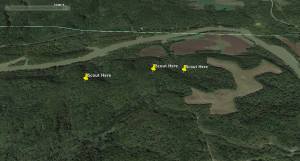
The area I was most interested in was a river bottom with two larger cornfields separated by a small strip of timber and a deep drainage cut running through. On the opposite side of the corn fields is a sharp elevation change, with what looked like a bowl feature at the top of the ridge. From what I could tell online, this area looked like it met all of my search criteria. I dropped a few pins on Google Earth and logged the GPS coordinates. Now it was time to put boots on the ground to confirm my online scouting assumptions.

Satellite image of the area I scouted. The pin to the far left will be the area I focus on this November
Ohio Public Land

Boots On The Ground

With my GPS coordinates logged, I set a date for a scouting trip to the Buckeye state. During the course of planning, my friend Tate and his buddy Eric decided to join me this fall and both were game for a late summer scouting trip. Two weeks before our scouting trip we had a meeting to iron out the details of where we were headed and the areas we’d be scouting. We met at Eric’s house and enjoyed a frosty pilsner as Eric gathered his folders containing the maps he’s used on his previous hunts in Ohio. I wasn’t sure where Eric had hunted in the past and was willing to change my hunting locations, even if he preferred a different county than I had scouted on line. After all, he’s been hunting Ohio Public land for years and would have a sense of where the better hunting would be.

We finished our beers and and Eric began pulling maps from his folder. At this point Eric has memorized land features, crop rotations cycles and perennial rub lines.  After sharing a few maps and thoughts, I asked what location he’d prefer to hunt.  As luck would have it, for 7 years Eric had been hunting the land I wanted to scout—it’s like we were meant to take this trip together. Having Eric on the trip would certainly cut down on some of the guess work.

4 a.m. came early on September 10th. I met the guys and we piled into my truck and headed west on the PA Turnpike, arriving at our destination around 8 a.m.  The food sources in this area were vast. Acres upon acres of corn and soybeans grew in every direction. There was no evidence here of the drought that we were experiencing across the state line. The timber was made up of a variety of hard wood with thick undergrowth—ideal whitetail habitat. The ridges were steep and the amount of green briar and brush made navigating the terrain difficult. The Google Earth images were as accurate as I’d hoped for.

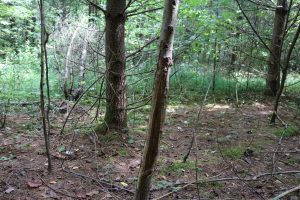
We scouted a few locations where Eric had hung a few stand in previous years before heading to the area that I was hoping would be my go-to spot. Once I got into the timber, I immediately noticed a handful of nice rubs at the base of the ridge. I began working my way up the ridge and came across several deer trails, with a well worn deer trail running diagonally up the ridge.

Rub from last year at the base of the ridge. This rub line runs the length of the ridge bottom.
Scouting Ohio Public Land

The entire ridge was thick and nasty with green briar. Once I made it to the top of the ridge, there was a small clearing in the brush with a tree that seemed well suited for a climber.  I also noticed this tree sat at the head of a drainage cut and on an edge where the brush gets almost impassably thick. The trails running the side of the mountain all led to this thick cover. It was clear deer were using the low lying feature of the drainage cut as an additional travel route and working the edge of the habitat change of the ridge top. This would be the location I’d focus on this November.

While scouting online I noticed the back side of this ridge had small depression between this ridge and the ridge just to the south. In general, I like terrain changes like this and in this steep country it seemed like a low lying area deer may use as an easier path to travel the ridge top.  I hiked out along the ridge top and dropped down the south side and into a bowl. There was buck sign everywhere along with some more well worn trails. This is one of those spots you get a feeling about. Something tells me this would be a great location and I’m pumped to spend some time hunting this area next month.

Final Thought

With my trip only a few weeks away, I feel confident about the locations I pinpointed in Ohio. My drive-by scouts consisted of pinch points leading into a food source  that I could clearly see on Google Earth and identify by driving past the location. The drive-by also confirmed what I assumed from my online scouting and the plan is to mix in these locations during my hunting trip. I’ll plan to hunt Ohio a few days during the first and second week of November, a few days in late November, and again in late season.

I’ve been looking forward to this trip for a year and am trying to keep my expectations reasonable. The possibilities and the unknowns of this trip, however intrigue me. Regardless of the outcome, the preparation, anticipation, and time spent with fellow hunters will keep me coming back for more.

Article

Video Tip: Annual Whitetail Habitat Shifts For Bucks

Are you watching a nice group of bucks that are calling your property home this summer? Only to be left wondering where they’ve gone this fall? I know I’ve experienced this.

As deer hunters we know  deer have very different needs depending on the season. If you’re interested in learning how to make your property a destination for bucks during the fall, enhancing your opportunities this hunting season, be sure to check out the quick video tip Whitetail Habitat Solutions below describing the annual whitetail habitat shift for bucks. Now, you may be able to find the bucks when they shift to their fall habitat.

Article

Video Tip: Practice Your Kill Shots

As archery hunters we like to spend plenty to time flinging arrows—we love shooting our bows! I’ve found there is a big difference between dialing in your consistency vs. practicing hunting shots. As I mentioned in a previous blog post, my goal this year is to extend my effective bow range (you can find out how here).  But extending my range will do me no good if I’m not able to effectively execute my shots in hunting scenarios come deer season.

Last year I began to implement more hunting scenario shooting. As often as I could, I’d use my climber and simulate a typical stand set. For me this included climbing with all my camera gear, taking anything I’d take during a hunt into the tree with me to practice. The goal was to make not just my hunting shot second nature. But to also create a system for my set up and tear down, making my assent and descent as effortless as possible (you can read more on my preseason practice here).  Luckily, this year my archery club has elevated platforms and blinds set up with 3D targets at variable yardages. So I’m able to execute plenty of simulated hunting shots at in-between distances. Hopefully all the offseason work at the range will prepare me to execute when the shot opportunity presents itself.

Below is a video from the Guys at Deer + Deer Hunting, sharing a few great tips on how to execute your kill shots in a practice scenario.

Article

Tips To Extend Your Bow Range


If you’re like me, you’ve spent your spring and early summer managing your habitat and food plots in preparation of the upcoming hunting season. Now it’s time to get those game cameras out, if you took them down,  to watch velvet bucks develop into what you hope are the hit list bucks you’ve been waiting for. I know how time consuming managing your hunting property can be and we often do it at the expense of equally important tasks. Now’s the time to extend your bow range and make sure you’re in bow shape come opening day.

Commit

In an earlier bog post, I mentioned that spending time with your bow is a great item to add to your whitetail off-season to-do list. Well this is one instance when I’ve taken my own advice and joined an archery club. This off-season I purchased a completely new set up; new bow, new release, and new rest. Needless to say, I need as much bow time as I can get until this new one begins feeling like an extension of my body.

As if breaking in a new bow isn’t challenging enough, I also set a personal goal to extend my effective bow range out to 40 yards. Living in the suburbs and with our farm being a 3 hour drive away, my best option to get in plenty of range time to meet my goal was to join the Wapiti Archers of Pennsylvania archery club 10 minutes from my house. They have everything I need: a nice bag range out to 50 yards, and two 3D courses with shot distances out to 50 yards. Now just going to the range alone isn’t going to help me, or you, achieve our goals; a plan is necessary.

Know Your Limits

Before beginning to extending your effective bow range, it’s necessary to understand the baseline your attempting to increase or enhance. A great way to test your current effective range is to shoot two separate groups of six arrows. If both groups fit within the diameter of a softball, then you can consider that your effective at that range and are ready to increase your distance. It’s important to be honest in this step. If you find yourself saying “close enough” during this step, you’ll need more time dialing in at a comfortable distance before adding yardage.

Form

One thing you’ll need to determine quickly is if you’re consistently using proper form. Small  quirks are of little consequence at the range shooting at bags and 3D targets.  Those small quirks are a different animal when in the stand dealing with a full blown case of buck fever. Do yourself a favor and head to a pro shop near you. The guys and gals at the pro shop can help even the worst form offenders and can help put you on track to more accurate shooting at longer distances. While you’re there, have them check your draw length and make sure your bow fits as it should. One of the most common reasons for an archer’s lack of consistency is due to an overly long draw length.

Less Is More

Now that your dialed in at your current effective range and you’ve addressed any form/technical issues, begin adding yardage to your shot. “Less is more” is absolutely one of the worst cliches known to man, but in this instance, it is the best advice to follow. Ideally you’ll want to add yardage in 5 yard increment, spending approximately a week at each new distance until you reach your goal range. This of course is only a guide, as some may be able to make a 10 yard jump.  If you find yourself struggling at the new distance, or worse yet experiencing target panic, it may be time to head back to close range practice (around 10 feet shooting into a blank target) to regain your form and confidence. Even the best archers will use the blank target method to tighten up their form, mechanics, and shot sequence.

Challenge Yourself

Once you’ve extended to your goal range, why stop there? Continue to extend your range. You may not ever take a 70-80 yard shot while hunting in the whitetail woods, but shooting accurately at more extreme distances can make your 20-40 yard shots on stand easier (I hesitate to call any shot in the whitetail woods a gimme).

Tips To Extend Your Bow Range

Final Thoughts

Extending your effective bow range from 20 to 30 yards nearly doubles the area you can cover from the stand. Thirty yards is my current effective range. My groups at this range are consistent and I’ve harvested whitetail just beyond this distance in the past. Ideally, I’d like to extend my effective range to 40 yards. At my archery club, I’ll be able to shoot out to 50 yards and I’ll have the opportunity to stretch that distance out to 55 or 60 yards when I’m at the farm. The process of extending my effective bow range won’t happen overnight, but I know that it will be time well-spent come this fall.